Overview
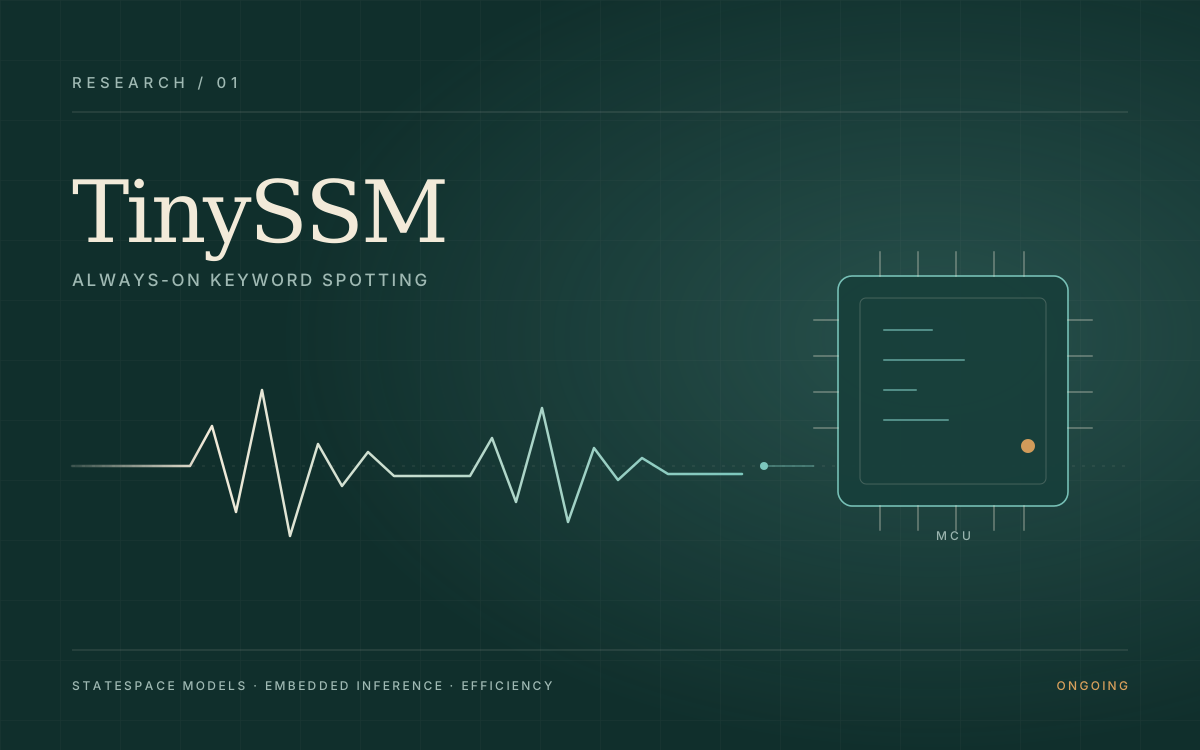
TinySSM is an exploration of state-space models for keyword spotting on microcontrollers. The goal is not simply to make a model smaller, but to find a design that fits the whole pipeline: preprocessing, inference, memory, and the energy cost of listening continuously.
Keyword spotting is a useful stress test for edge AI. The task is narrow, the input is continuous, and the device may have only a few hundred kilobytes of memory. A model that is accurate in a notebook but cannot run within those limits is not yet a solution.
Motivation
Always-on sensing changes the design problem. Inference is no longer a single request that can wait for a GPU; it is a background process competing with everything else on a small device. Efficiency therefore has to be considered at the level of the full system rather than as a single accuracy-per-parameter number.
State-space models are appealing in this setting because they process a stream with a compact recurrent state. Whether that theoretical advantage survives quantization, fixed-point arithmetic, and the realities of an embedded toolchain is the interesting question.
Approach
The work is organized around a few practical questions:
- How small can the model be while remaining useful for a constrained vocabulary?
- Which parts of the architecture dominate memory once the model is deployed?
- How do quantization and fixed-point inference affect the model’s behavior?
- Where is the real latency bottleneck: the model, the front end, or the surrounding firmware?
I am treating this as an iterative engineering study. Each version should be measurable on the target hardware, and negative results should be recorded rather than hidden.
Current status
This project is ongoing and exploratory. No benchmark claims are published on this site yet. When results are available and reproducible, they will be added to the project page and, if appropriate, submitted for peer review.
Open questions
- Can the recurrent state be kept small enough for the tightest MCU tier?
- Does the streaming advantage hold when the audio front end is included?
- Which training-time choices make the model more robust to low-precision deployment?
If you are working on related problems in TinyML or efficient sequence models, the contact page explains how to get in touch.